eComexi FAQs
3.- Is EB technology a new concept?
4.- What does e-COMEXI stand for?
5.- Are UV and EB system the same technology?
6.- What are the differences between UV curing and EB curing?
8.- Is there any radiating equipment?
9.- Has EB Flexo technology an instant curing?
11.- Is there any need of dryers?
12.- Will the system impact on cost per produced square meter?
13.- What is the maximum print quality?
14.- What is the maximum printing speed for a industrial EB Flexo process?
15.- What do Brand-owners feel about this technology?
16.- How can I test the e-COMEXI technology?
1.- What does EB stand for?
EB means Electron Beam.
2.- What is EB curing?
In EB curing, a curtain of accelerated electrons is emitted towards
the web in an evacuated chamber. The highly energetic electrons
pass through a titanium window foil towards the web in a nitrogen
inerted process zone. When the energetic electrons hit
the wet ink or coating, the energy is absorbed by the ink layer
and the curing process takes place, instantaneously without the
need for a photoinitiator.

3.- Is EB technology a new concept?
EB is not new. It has been used in the offset printing industry for decades.
EB cross linking of high barrier shrink films for food packaging applications
has been commercial for several years. EB sterilization for the pharmaceutical
and bio medical device industry is a well established process and has been
commercial since the sixties and seventies.
What is new is the usage of EB process for the flexography industry and the flexible
technology with a proven industrial solution. The name given to it is: “e-COMEXI”.

4.- What does e-COMEXI stand for?
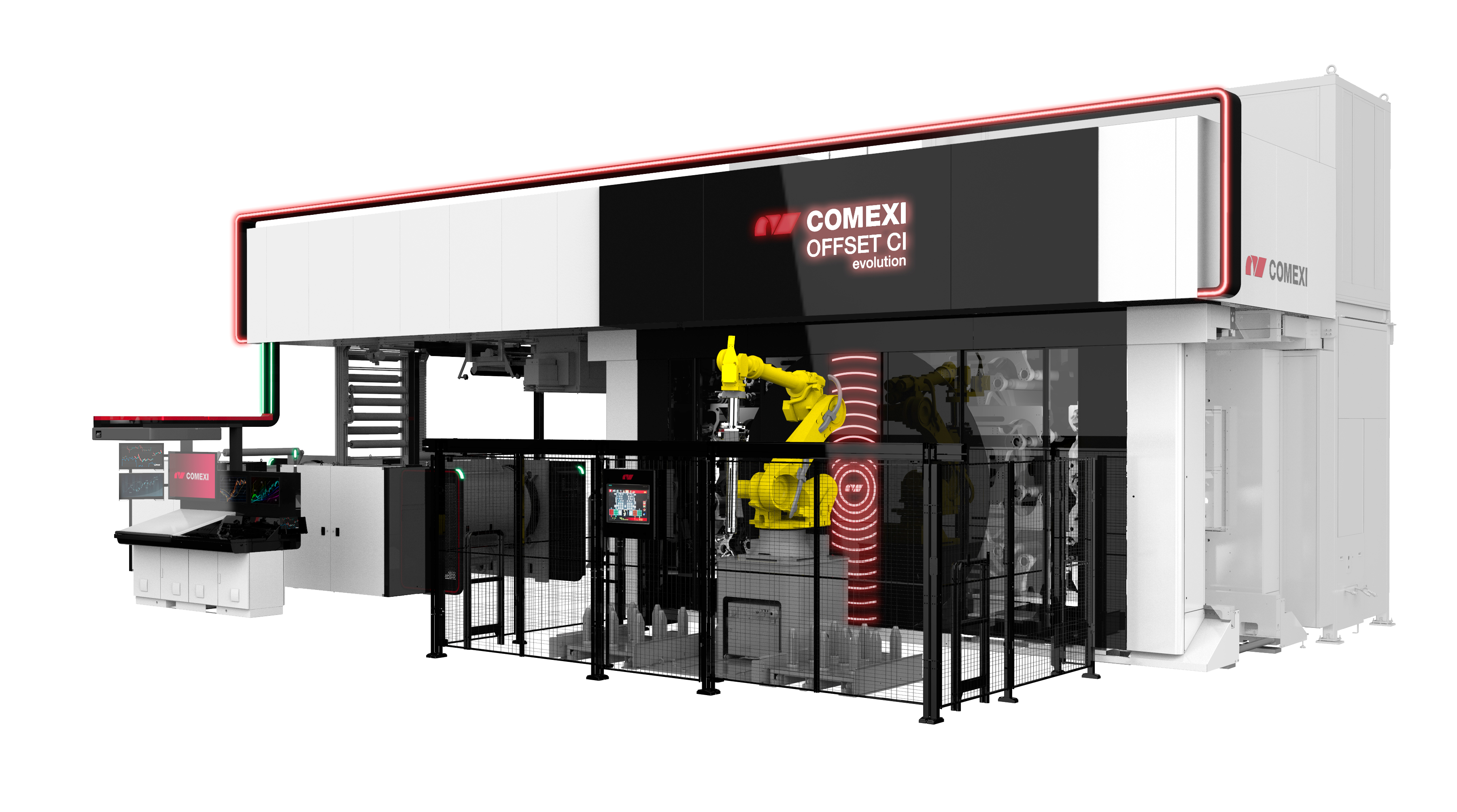
e-COMEXI the new Comexi’s brand to describe the portfolio of solutions
which cover the EB flexo printing, EB coating and other EB-driven technologies
in order to increase the final added-value of the packaging in a sustainable
and VOC-free manner.
e-Comexi strives to support and develop ´green technology´, reducing
the use of VOC´s (Volatile Organic Compounds) like solvents and help
to reduce the emission of Green House Gasses (GHG).
An EB press reduces the carbon footprint to about 1/3 of a conventional press
(only electricity load). Investments in incinerators are obsolete with EB technology.
5.- Are UV and EB system the same technology?
From the curing point of view both of the ink systems use an external
radiation energy source. The UV radiation is not powerful enough
to start the polymerisation process and requires the help of
a photoinitiator. EB inks do not use such photoinitiators since
the electrons can start the reaction by themselves. Therefore
the EB inks are potentially cheaper.
6.- What are the differences between UV curing and EB curing?
- UV Curing
- Excellent print quality
- VOC free inks
- High Rub and chemical resistance
- Use of photoinitiators (PI's)
- High Cost
- Food compliant ink series extremely costly
- Face restricted level of acceptance with Brandowners
- Several degrees of curing are seen
- No autocleaning possible (time and cost)
- Wah up with solvents (health)
- Very high viscosity (500 - 1000 mPas)
- EB Curing
- Excellent print quality (same Q as UV inks)
- 100 % VOC free process
- High Rub and chemical resistance, High Gloss
- No Use of photoinitiators (PI's)
- Same integral Cost as SB inks
- Food compliant inks by nature
- Enjoy increasing interest with brandowners
- No degrees of curing are seen. On or Off
- CI Autocleaning possible (time and cost)
- Wash up with water (health and waste savings)
- Viscosity like SB inks (120 - 280 mPas)
7.- Is EB a safe technology?
It is a perfect safe technology and in use already since the 60-ties.
The electron beam equipment is an electrical apparatus which
can be switched on and off.
The elimination of any solvents in the operations, means a safer
labour environment and a reduction of insurance cost. EB treated
materials do not show any systematic toxicity and are not carcinogenic.
Print jobs have been researched by known food safety test institutes
(like e.g. Fabes in Germany) and all provided samples have passed
the compliance requirements to food safety. However, it must be
noted that it is advised that the responsibility remains with the
printer to execute according good manufacturing principles and
file for food compliance certificates.
8.- Is there any radiating equipment?
When electrons hit metal, X-ray radiation is emitted. Therefore,
the equipment is covered in a stainless steel and lead shielding
to absorb the X-ray energy. None of this radiation is emitted
outside the process zone of the EB equipment. It is not a hazardous
equipment. EB equipment is electrical, and when it is off there
are no electrons or X-rays emitted.
9.- Has EB Flexo technology an instant curing?
Yes, the cure achieved is instantaneous and effective. It enables
the printer/converter to post process like coating or lamination
in-line. There is no cure time and one can slit and ship immediately
after coming off the press. The EB technology enables JIT (Just
in time) printing and converting that significantly shortens
the time to market.
10.- What is nitrogen for?
The process is under an inert atmosphere of nitrogen. The air that
we breathe contains 78% nitrogen, but is not pure enough as the
oxygen in the air inhibits the curing process and result in the
generation of ozone. To increase the efficiency of curing and
avoid the generation of ozone, the treatment process zone needs
to be maintained with oxygen levels below 200 ppm (part per million).
11.- Is there any need of dryers?
The drier is just the EB energy source to cure the inks. No additional
dryers, blowers or with cold or hot air are required, with corresponding
energy savings.
12.- Will the system impact on cost per produced square
meter?
Ink cost has a significant impact on the final cost. Although energy
curable inks are higher in cost per volume unit, the consumption
is much lower. The offset balance is cost neutral, otherwise
the system could not be commercial attractive.
Detailed cost calculation models are available to calculate accurately
the T.C.O. (total cost of Ownership). The model is parameterized
flexible and to dedicate it to your specific situation in your
company. It gives a clear insight in the cost, comparing solvent
base printing with EB.

13.- What is the maximum print quality?
Any plate-lineature up to 70 l/cm can be used in an industrial process.
14.- What is the maximum printing speed for a industrial
EB Flexo process?
The speed of the curing process is subject to the energy
dose. For print processes, a dose level of 30 kGy is used. This
energy can cure wet inks to up to 400 m/min (1300 ft/min). The
ink system is based in wet-in-wet trapping, whereas the viscosity
is trapped to secure a sequential lay-down wit. At present,
Comexi is leading the development process of EB technology hand
in hand with Sun Chemical and ESI. Speeds up to
350 mpm are consistent in print quality. In the months to come,
Comexi, Sun Chemical and ESI strive to increase even further improved
performances.

15.- What do Brand-owners feel about this technology?
Brand-owners are on the continuous look out for innovative solutions
to differentiate themselves. Improvement of print quality, shorter
time to market and lower cost are continuous key drivers. EB
technology ensures the compliance to these drivers, but moreover
address the growing attention to reduce their carbon footprint.
If a new technology can improve quality, shorten time to market
and support the print industry with a sustainable solution WITHOUT
increased cost, brandowners show appreciation and a growing interest.
16.- How can I test the e-COMEXI technology?
Nowadays we are mass-producing the first e-COMEXI press, the E-COMEXI
FW1508. Starting in February 2010, we offer the opportunity to
carry out industrial runs in our R&D Centre on a full EB
equipped press. A first-class production environment will
be provided, with state-of-the-art technology for our customers.
Contact our sales representative in your country (go to “Sales” area
in the corporate web site) or email at comexi@comexigroup.com